
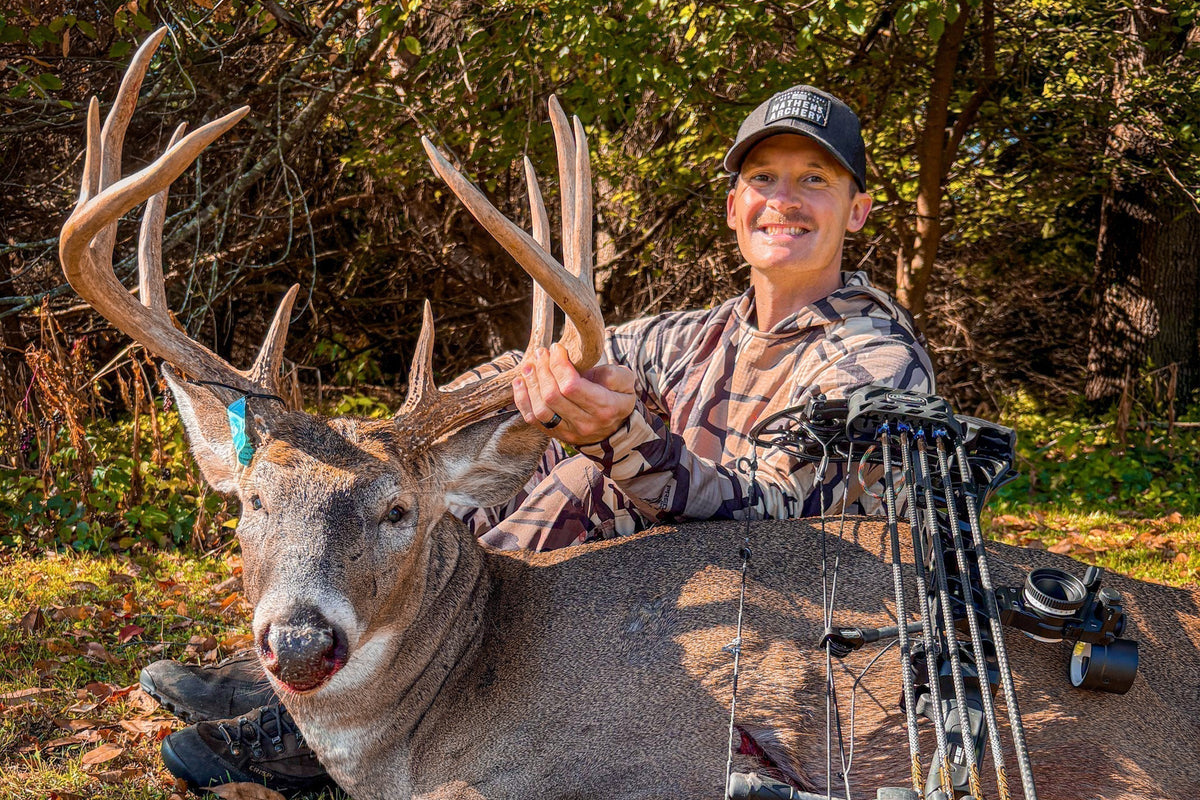
It was November 16th, and I found myself in the middle of nowhere on public land in the land of Lincoln, Illinois. I had just come off a very uneventful morning hunt and pulled off to the side of the road to study the maps and come up with a plan for the evening sit.
I wasn’t looking for anything complicated. Just a spot I could drop into blind and potentially cross paths with a late cruising rut buck. The kind of buck covering ground, nose down, looking for the next receptive doe.
Two spots on the map stood out immediately. Both read like natural funnels where deer movement would naturally compress. One was bigger, more spread out. The other was tight, subtle, and easy to overlook. I opted for the smaller funnel, figuring that if a buck did cruise through there, it would force him into bow range and put him right in my lap for a close archery shot.

Sometimes during the rut, the best play isn’t overthinking it. It’s finding the terrain that forces movement and being there when a buck slips through.
After making my way in through my planned access, I picked a tree and got everything dialed in for the evening. It wasn’t long, maybe 90 minutes, before the woods started to come alive. Off in the distance I could hear what sounded like two bucks grunting as they pushed their way through the bigger funnel.
The grunts got louder as they worked through the thick cover, and eventually I caught movement. When I finally laid eyes on them, it was exactly what I thought. Two bucks slipping through the funnel together. Both were solid deer, the kind most hunters would be thrilled to see. But they weren’t the one I was there for.
Those two bucks showed me exactly what I needed to see. They worked their way through the larger funnel and then angled up the side hill of the ridge that made that funnel so effective. They never came into bow range, but the information they gave me was enough. That instantly told me I needed to move and move now.
With about an hour and a half of daylight left, I packed up my setup and made a 54 yard move right into the heart of the larger funnel. I got set back up, dialed in, and settled in for the last hour of daylight.
It was definitely pushing it to make a move that late in the evening. But I figured at the very least I’d be perfectly set up for the morning.

Forty five minutes later, here he comes. The kind of buck you travel to Illinois for, a 151”, 13 point.
He worked through the funnel and closed the distance to 9 yards, before finally offering a clean shot at 30 yards. I settled the pin and let it eat. The buck was smoked.
The skies were clear and the stars were bright that night. As I sat beside him, taking a moment to pay him the respect he deserved, I couldn’t help but think about what that night might have looked like if I hadn’t made that 54 yard move.
I truly believe that buck would have taken the same steps the two bucks before him did, skirting just out of range and slipping up the ridge.
That small adjustment was the difference between watching a giant walk away and putting my hands on him under a sky full of stars.
Mobile hunting isn’t a trend. It’s a return to what makes bowhunting lethal, mobility, adaptability, and the willingness to move when others won’t.

Mature whitetails survive because they adapt to pressure faster than most hunters adapt to them. When you stay stagnant, you fall behind. When you stay mobile, you stay in the game.
Mobile hunting isn’t about carrying less weight. It’s about carrying the right weight. Experience, woodsmanship, confidence in reading terrain and the willingness to fail forward.
Stagnant hunters hope. Mobile hunters adapt. And in the chess match against a mature whitetail, the one who adapts faster usually wins. Mobility isn’t easy. It’s uncomfortable. But uncomfortable is where giants live.

Share: